.jpg)

To choose a top realtor to list and sell your home in Toronto in 2026, look for an agent with verifiable recent transaction history in your specific neighbourhood, a written marketing plan that goes beyond MLS, a transparent commission structure with clearly defined service levels, and a track record built on repeat and referral business. Interview at least two agents, ask specific questions about their pricing methodology and communication process, and verify their numbers before signing a listing agreement.

Before you interview a single agent, you need to understand the conditions you are selling into. That context will help you evaluate whether the advice you receive is grounded in reality or designed to win your listing.
According to TRREB's May 2026 Market Watch, the GTA resale market is showing early signs of tightening:
GTA home sales reached 6,583 in May 2026, up 6.3% compared to May 2025. At the same time, new listings fell to 17,698, down 18.9% year over year. Active listings across the GTA sat at 26,927 at the end of May. The average selling price was $1,069,700, down 4.6% from May 2025.
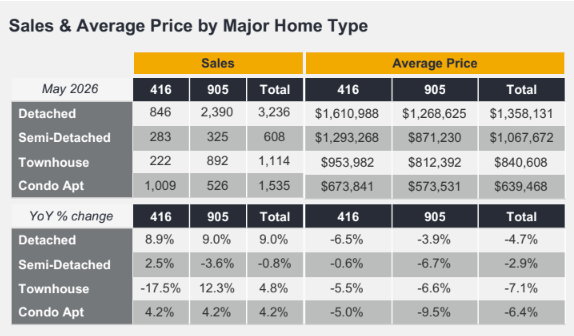
The MLS Home Price Index Composite benchmark came in at $946,500, down 6.7% year over year. By property type, detached homes averaged $1,358,131, townhouses averaged $840,608, and condo apartments averaged $639,468.
The average listing days on market was 27 days. The average property days on market, which tracks total time on market regardless of re-listings, was 42 days. The average sale-to-list price ratio was 98%.
What this tells you as a seller is that the market is at an inflection point. Sales are rising, new supply is falling, and competition between buyers is beginning to build in certain neighbourhoods. But buyers still have meaningful selection and are negotiating an average of 2% below list price. That gap between motivated sellers and selective buyers is exactly where agent quality determines your outcome.
Most sellers know they need an agent to list their property on MLS. That is where clarity usually ends.
A listing agent's responsibility covers the entire transaction from well before launch to final close.
Before listing: pricing analysis based on current comparable sales, property preparation guidance, staging coordination, professional photography and video, written marketing plan, and listing copy.
During the listing: buyer agent outreach, open house coordination, showing management, regular seller updates, and pricing strategy review as market feedback accumulates.
During negotiations: offer review and analysis, counter-offer strategy, conditional period management, and coordination with lawyers through to closing.
In a market where new listings are declining and sales are rising, a well-prepared listing captures that momentum. A poorly executed one misses it. There is no passive version of good representation in 2026.
Walking into an agent interview without basic market knowledge puts you at a disadvantage. You need to be able to evaluate whether a pricing recommendation reflects current conditions or whether an agent is telling you what you want to hear.
The TRREB data from May 2026 gives you a factual baseline:
Sales are trending up year over year. New listings are trending down sharply. That combination means sellers who enter the market with a strong listing in the right price range are better positioned today than they were 12 months ago. But the average property still takes 42 days to sell, and buyers are still negotiating below asking. Pricing accuracy is not optional.
By property type, conditions vary significantly. Detached homes are a different market than condo apartments. The 416 is a different market than the 905. A GTA average tells you almost nothing useful about your specific property. The agent you hire should be presenting you with neighbourhood-level data, not city-level averages.
When an agent presents a pricing recommendation, ask which comparable sales they used, when those sales occurred, and how they adjusted for the differences between those properties and yours. Recent means within 90 days. Anything older than that carries reduced weight in a market that has been shifting.
Most sellers choose an agent from a personal referral or a yard sign in the neighbourhood. Both are reasonable starting points. Neither is sufficient on its own.
Referrals from people who have sold recently are worth more than general reputation. Ask specifically: was the agent proactive? Did you feel informed throughout the process? Would you use them again?
Neighbourhood transaction history is verifiable. Look at which agents have listed and sold properties similar to yours in your specific area over the last 12 months. Recent local volume is more relevant than career-level credentials or brokerage size.
Online reviews tell you about communication quality and client experience. Read for patterns across multiple reviews rather than standout quotes. An agent who consistently earns repeat business and referrals from past clients is demonstrating something that reviews cannot be manufactured to show.
Interview at least two agents. One interview gives you no reference point. Two or three gives you enough to recognize when someone is being direct versus when they are performing.
Generic questions produce generic answers. These questions are designed to surface meaningful differences.
On pricing: Walk me through the comparable sales you used to arrive at this number. What was the most recent sale and when did it occur? How did you adjust for differences between those properties and mine?
A strong answer is specific and data-backed. A weak answer is a confident number with vague reasoning.
On marketing: Can I see your written marketing plan for a listing at this price point? What channels will you use beyond MLS? How does paid advertising work and what does it cover?
A strong answer includes a written plan you can review before signing. A weak answer describes basics that any agent does as a baseline.
On communication: How often will I hear from you once the listing is live? What does a typical update include? What is the process if a week goes by with no activity?
A strong answer describes a structured schedule with specific touchpoints. A weak answer says something like "I am always available."
On commission: Walk me through your commission structure and what is included at each level. Are there any costs I should expect beyond the commission?
A strong answer is transparent and itemized. A weak answer deflects to what is standard in the market.
On track record: What was your average days on market for listings in this neighbourhood over the last 12 months? What was your average sale-to-list price ratio? What percentage of your business comes from repeat clients and referrals?
A strong answer gives you specific, verifiable numbers. A weak answer pivots to credentials or career stats.
Every agent will arrive with materials designed to win the listing. Here is how to separate substance from presentation.
The pricing recommendation: Is it grounded in a neighbourhood-specific comparable market analysis using recent sales? Or is it a round number delivered with confidence? Overpricing is one of the most costly mistakes in Toronto real estate. A property that sits accumulates a market stigma that buyers notice. By the time the price is reduced, the most motivated buyers have moved on. The agent who prices accurately from day one protects your equity and your time.
The marketing plan: Does it exist in writing before you sign? Does it include video, professional photography, and paid advertising as standard? Or is MLS the primary strategy? In a market where 26,927 properties are actively competing for buyers, your listing needs to be found and compelling. Passive marketing in this environment produces passive results.
The commission structure: Is it clearly explained with defined service levels? Or is it a single number presented without context? Transparency in the commission conversation predicts transparency throughout the transaction.
How they handle difficult questions: Ask what the plan is if the property does not sell in the first 30 days. Ask how they have handled price reductions in the past and what triggered them. The agents who answer these questions directly are the ones you want. The agents who deflect are showing you something.
Everything an agent tells you in a presentation should be verifiable before you execute a listing agreement.
Transaction history: Ask for a list of recent sales in your area and cross-reference addresses on MLS to confirm they were the listing agent.
Performance metrics: Ask for their average sale-to-list price ratio and average days on market in writing. An agent with a genuine track record will provide these willingly.
License status: All Ontario realtors are registered with the Real Estate Council of Ontario. You can verify license status and any disciplinary history at reco.on.ca.
Brokerage standing: The brokerage behind the agent provides compliance oversight and transaction management support. A well-established brokerage adds a layer of accountability that protects both agents and clients.
The listing agreement is a legally binding contract. Read it in full before signing.
Listing period: Most agreements run 60 to 90 days. Understand what your options are if the property does not sell within that window.
Commission structure: The agreement specifies total commission and how it splits between the listing brokerage and the buyer's agent. Confirm what was discussed verbally is reflected in writing.
Holdover clause: Most agreements include a holdover period of 30 to 60 days after expiry. If a buyer introduced during the listing period completes a purchase within that window, commission is still owed. Understand the terms before signing.
Cancellation conditions: Ask what happens if you need to take the property off the market. Know what you are committing to.
The data tells a nuanced story right now. Sales are up 6.3% year over year. New listings are down 18.9%. That combination signals a tightening market, which benefits sellers who are positioned well.
At the same time, average property days on market sits at 42 days and buyers are negotiating an average of 2% below list price. The market is not yet back to conditions where almost any agent and any price produces a satisfactory result.
That gap is where the quality of representation matters. A seller with an accurate price, a strong marketing plan, and a team that communicates proactively is entering a tightening market from a position of strength. A seller with a flat listing and passive representation is entering the same market at a disadvantage.
The agents who navigate this environment well are the ones who have developed genuine process competence over multiple market cycles, not the ones who happened to start selling during a peak.
After all the interviews and comparisons, there is one question that reveals more than any credential or sales award:
What percentage of your business comes from repeat clients and referrals?
An agent who consistently earns repeat business and referrals from past clients is an agent whose track record speaks for itself. That pattern cannot be manufactured. It is earned through consistent performance over time, in good markets and difficult ones.
In 2026, with 26,927 active listings and buyers who are selective and patient, that kind of agent is the one you want negotiating on your behalf.
Interview at least two agents. Ask specific questions about pricing methodology, the written marketing plan, communication cadence, and commission structure. Verify their local transaction history and performance metrics before signing. Read the listing agreement in full. And weight repeat client and referral percentage heavily when making your final decision.
The right agent does not just list your property. They protect your equity, your time, and your confidence through a transaction that matters.
If you want to walk through what your specific situation looks like in the current market, I am happy to have that conversation.
[Book a Seller Consultation → ryan@connect.ca]
How do I find a top realtor to sell my home in Toronto in 2026?
Start with referrals from people who have recently sold in your area and ask specifically about communication, proactivity, and whether they would use the same agent again. Cross-reference with neighbourhood transaction history to verify recent local sales. Interview at least two agents before deciding, and verify their days-on-market and sale-to-list price ratios before signing a listing agreement.
What is the Toronto real estate market like for sellers in 2026?
According to TRREB's May 2026 Market Watch, GTA home sales increased 6.3% year over year to 6,583 transactions, while new listings declined 18.9% to 17,698. Active listings sat at 26,927. The average selling price was $1,069,700, down 4.6% from May 2025. Average property days on market was 42 days and the average sale-to-list price ratio was 98%. The market is tightening but buyers retain negotiating power, making agent quality a significant factor in seller outcomes.
What is the average days on market for homes in Toronto in 2026?
According to TRREB's May 2026 Market Watch, the average listing days on market was 27 days. The average property days on market, which accounts for total time on market regardless of re-listings, was 42 days. Both figures are up modestly year over year from 25 and 39 days respectively.
What commission should I expect to pay to sell my home in Toronto?
Commission structures vary by brokerage and service level. Tiered structures at 2%, 2.5%, and 3.5% are common, each with defined service offerings. The total commission typically includes a split between the listing brokerage and the buyer's agent. Ask for a clear written breakdown of what each level includes before signing.
What questions should I ask a Toronto listing agent before hiring them?
Ask for the comparable sales behind their pricing recommendation and when those sales occurred. Ask for a written marketing plan. Ask about their communication cadence during an active listing. Ask for their commission structure with defined service levels. Ask for their average days on market and sale-to-list price ratio for the last 12 months. Ask what percentage of their business comes from repeat clients and referrals.
What should I look for in a listing agreement in Ontario?
Review the listing period, total commission and split structure, holdover clause duration, and cancellation conditions. Confirm every verbal commitment from the presentation is reflected in the written document. If anything is unclear, ask for clarification before signing. You are entering a legally binding contract.
Is now a good time to sell a home in Toronto?
Based on TRREB's May 2026 data, conditions are improving for sellers. Sales are up 6.3% year over year and new listings are down 18.9%, signalling a tightening supply picture. Prices remain below their 2025 levels, but the directional trend is stabilizing. Sellers who enter the market with accurate pricing and strong representation are better positioned now than they were six months ago.