
The headlines this week have been impossible to miss. For the first time in years, the Greater Toronto Area's average home price dropped below $1 million, landing at $973,289 in January 2026. News outlets are calling it historic. Some are suggesting panic. But if you look past the number itself and into what actually happened in the market, you see something very different: a market adjusting, not collapsing.
Let's break down what January's data actually means, why the numbers look the way they do, and what this tells us about the months ahead.
An average price only tells you what sold. It doesn't tell you what your home is worth. This distinction matters, especially in a diverse market like the GTA where property types range from $500,000 condos to $3 million detached homes.
In January, detached homes averaged $1,277,915, down just 2.8% compared to last year. Semi-detached homes averaged $945,967, down 9.7%. Townhouses came in at $819,543, and condos averaged $604,759. When you see those ranges, the story becomes clear. More condos traded in January. Fewer detached homes traded. When the mix shifts toward more affordable property types, the average drops, even if individual home values are holding relatively steady.
Your detached home in Leslieville or Oakville didn't lose 6.5% of its value overnight. The GTA just saw more transactions at the lower end of the price spectrum. That's a math problem, not a market collapse. It's the same reason the average price spikes in June when detached homes in premium neighborhoods dominate sales. The mix drives the number.
.jpeg)
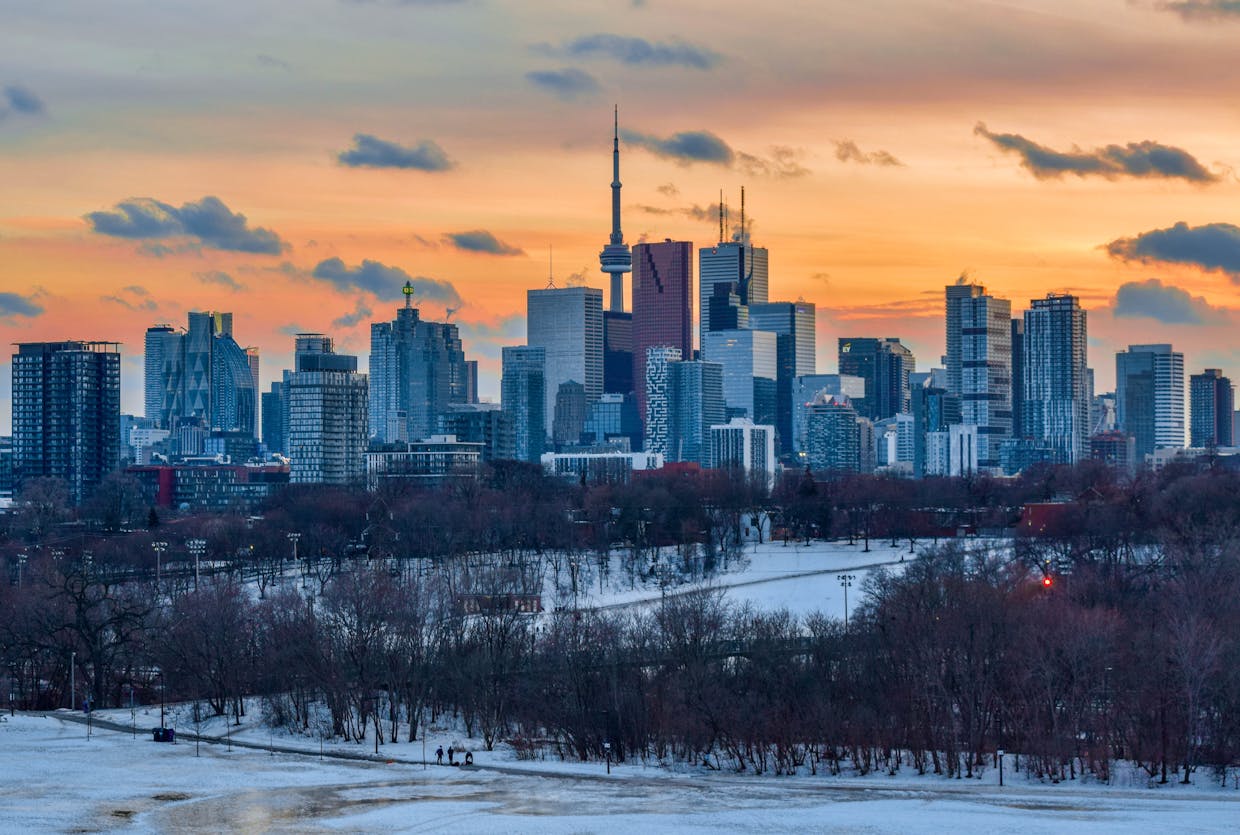
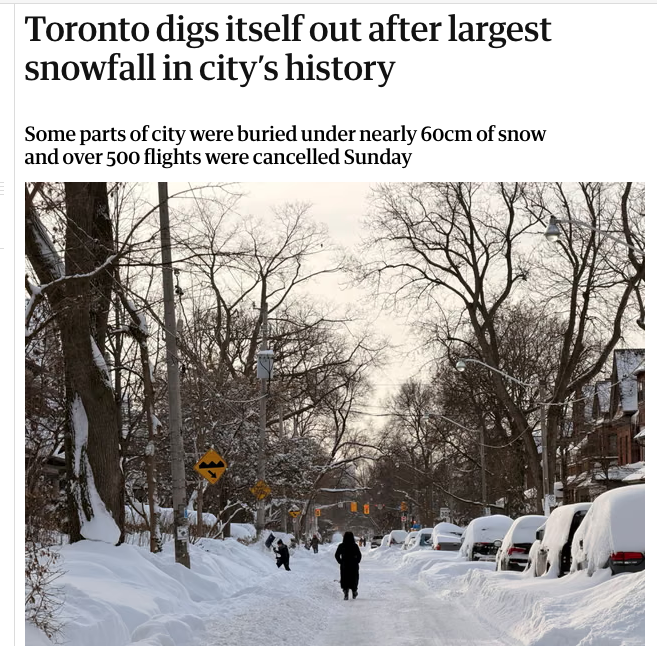
Sales totaled 3,082 homes in January, down 19.3% from the same month last year. On the surface, that looks concerning. But context changes everything. People returned to work and school on January 5th after the holidays. Within days, the GTA was hit with record snowfall and some of the coldest temperatures we've seen in years. Showings stopped. Open houses got cancelled. Buyers who were casually browsing in December stayed home.
The weather didn't just slow the market. It froze it. When you compare December sales to January sales, the drop is obvious. And February has brought more of the same conditions. We're likely not going to see buyers return in any meaningful way until March, when the snow clears and people can actually tour properties without risking frostbite. January's numbers reflect seasonality and weather as much as they reflect underlying demand. This is not a structural shift. It's winter in Canada.
The GTA is not one market. It's dozens of micro-markets operating under different conditions. Leslieville isn't Liberty Village. North York isn't Oakville. Riverdale isn't Yonge & Englinton. Some neighborhoods saw detached home prices hold firm or even tick up slightly.
Others saw condos move faster than the GTA average would suggest. Location matters. Property type matters. The quality of the home matters. A well-maintained detached home in a walkable neighborhood with good schools is not experiencing the same market conditions as a condo in a less desirable area.
This is why sweeping regional headlines can be misleading. If you're trying to understand what's actually happening with your property or in the neighborhood you're considering, you need data specific to that area. The GTA-wide number is a starting point. It's not the full story.
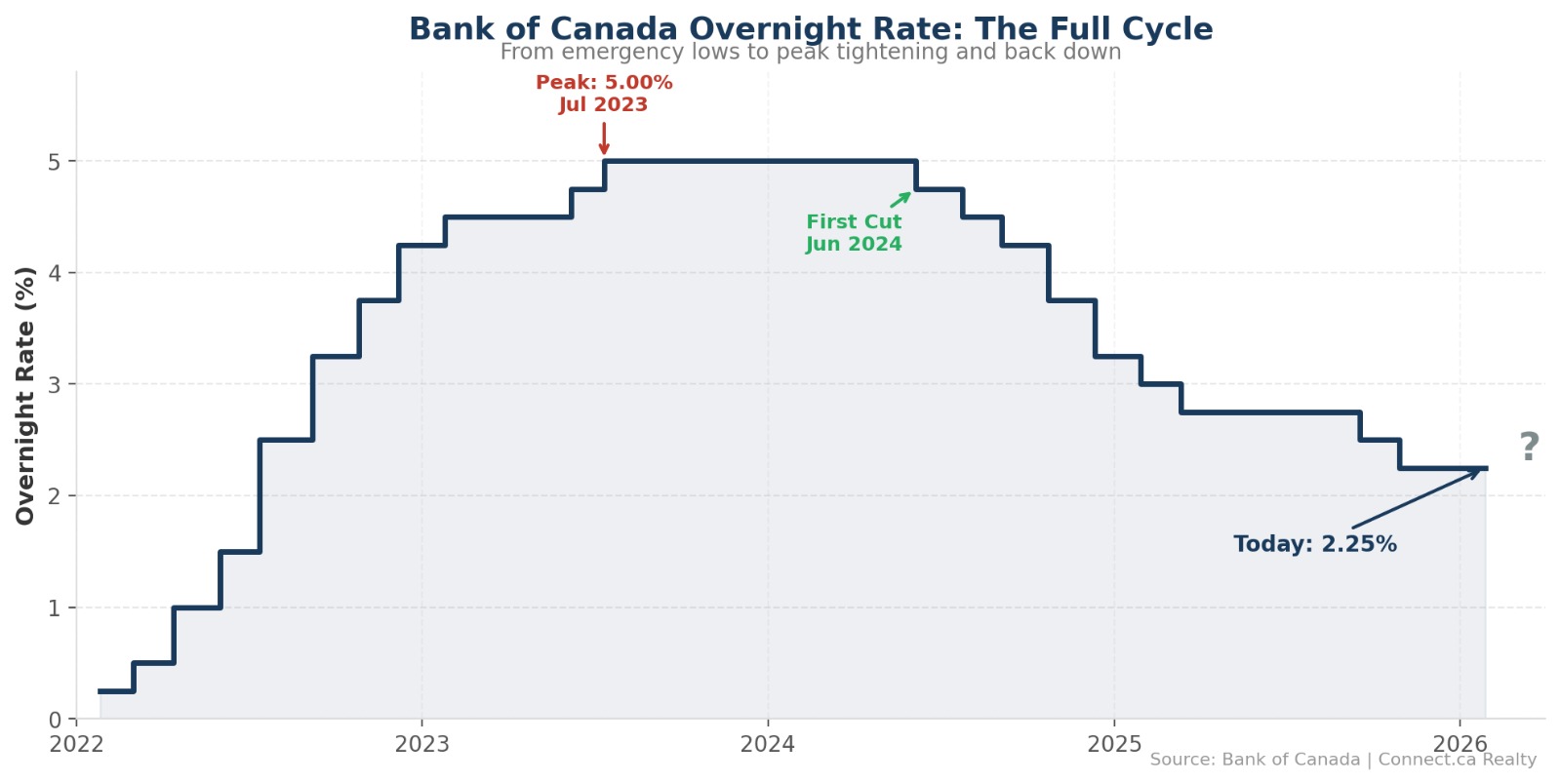
Here's what's actually changing in the market, and it's the most important shift we've seen in two years. Interest rates have been stable for months. The Bank of Canada overnight rate has held at 2.25 Basis points since the fall. Fixed mortgage rates are predictable. Buyers are no longer waking up to another rate hike mid-search. They can plan. They can budget. They can make decisions without worrying that the goalposts will move before they close.
Rate consistency creates confidence. And confidence is what brings buyers back into the market. For the first time since early 2022, buyers have a clear picture of what they can afford and what their monthly payments will look like over the term of their mortgage. That clarity is worth more than a 5% price swing when it comes to making a major financial decision. Buyers aren't just looking for a deal. They're looking for certainty. We're finally starting to see that.
The Toronto Regional Real Estate Board released their 2026 Market Outlook alongside January's data, and their expectation is straightforward. They're forecasting a better second half for sales. They're not calling a boom. They're not predicting a return to 2021 frenzy. They're saying that as conditions settle, transactions will pick up. That's a measured, reasonable outlook based on what typically happens when rate stability returns and seasonal activity normalizes.
Spring is historically when the GTA market wakes up. Families with school-age children start looking. Sellers who held off through the winter list their properties. Inventory rises, and so does buyer activity. If we add stable rates and improved weather to that seasonal pattern, the second half of 2026 could look very different from January's frozen landscape.
We're not operating in a vacuum. There's still uncertainty around tariffs and trade policy, and that creates hesitation for some buyers and sellers who want total clarity before making a move. It's understandable. When the news cycle is dominated by policy shifts and economic speculation, it's natural to want to wait until everything settles.
But here's the reality. Waiting for perfect certainty means waiting forever. There will always be something on the horizon. A policy change. A global event. A shift in economic conditions. The question isn't whether uncertainty exists. It's whether the fundamentals are strong enough to move forward despite it. And right now, the fundamentals are clearer than they've been in two years. Rate stability is real. Price adjustments have already happened. Inventory is constrained but not absent. For buyers and sellers who are ready, this is a workable market.
If you've been waiting for clarity, this is it. Rates are stable. Prices have adjusted from their 2022 peaks. Properties are taking longer to sell, with the average sitting on the market for 45 days. That means you have time to evaluate without competing against five other offers on day one. You can negotiate. You can ask for concessions. You can conduct proper due diligence.
This is an especially strong window if you're buying for your kids. You're not trying to time the peak or catch the bottom. You're giving them a foothold in a market that has stabilized while affordability is still within reach. Real estate remains one of the most effective long-term wealth-building tools, and buying when others are hesitant has historically been a sound strategy.

January was slow by design and weather. That's not news. But if you're thinking about listing in the spring, understand this. Inventory is still down 13.3% year-over-year. Well-priced homes in strong neighborhoods are still moving. The homes sitting longer are the ones that are overpriced relative to today's reality. If you price to the market and present your property well, you'll find your buyer. The key is realistic expectations. We're not in a seller's market where homes sell over asking in three days. We're in a balanced market where properly priced homes move at a reasonable pace. Work with that reality, and you'll have a successful sale.
The "below $1 million" headline makes for dramatic news coverage, but it doesn't tell the full story of what's happening in the GTA real estate market. When you account for the mix shift, the weather impact, and the broader context of rate stability and seasonal patterns, January's data looks a lot less alarming and a lot more like a market in transition. If you want to understand what's actually happening in your specific neighborhood, or if you're thinking about buying for yourself or your kids and want to know what's realistic in today's market, reach out. The data that matters isn't the GTA-wide average. It's the data specific to your situation.