If you've been following the news lately, you'd be forgiven for thinking Toronto's best days are behind it. Tariff fears, recession talk, and political uncertainty dominate every headline. But there's a parallel story unfolding in this city that almost nobody is covering, and it's one that matters far more for long term real estate fundamentals than any single month of market data.
Over the past several months, some of the largest companies in the world have made major financial commitments to Toronto. Not announcements or letters of intent. Signed leases, capital deployed, and offices opening. At the same time, Canada's biggest banks are scrambling to find space downtown, AI companies are scaling at a pace few predicted, and the largest transit infrastructure project in the city's history is actively under construction. Here's the full picture.
The headline number is Microsoft's commitment of $19 billion CAD to expand AI infrastructure across Canada, with a significant portion directed at its Azure Canada Central region based in Toronto. Microsoft has described this as the most important investment in its Canadian history, with more than $7.5 billion earmarked for the next two years alone and new data centre capacity expected to come online in the second half of 2026. (Source: Microsoft Blog, Dec 9, 2025)

But Microsoft is far from the only global company planting its flag here. Lyft chose Toronto as its second North American tech hub after San Francisco, leasing 90,000 square feet at First Canadian Place for several hundred employees across engineering, product, and operations. (Source: Lyft Blog, Oct 2025) Marvell Technology committed $238 million over five years to expand semiconductor R&D in Ontario, creating up to 350 high value jobs. (Source: Invest Ontario, Dec 1, 2025) NVIDIA signed a new 32,000 square foot downtown lease at Portland Commons on 530 Front Street West. (Source: CoStar, Oct 2025) And procurement platform Zip expanded its Toronto footprint fourfold, calling the city its second major engineering hub after growing its local headcount by 250% year over year. (Source: BusinessWire, Nov 2025)
On the homegrown side, Wealthsimple leased an entire building at The Well (460 Front Street West) to house its 1,000 plus employees. (Source: Wealthsimple Newsroom, Dec 2025) And Cohere, the Toronto founded AI company, raised over $600 million USD in 2025 and reached a $7 billion valuation while tripling revenue, with CEO Aidan Gomez telling the Globe and Mail he expects dramatic growth again in 2026. (Source: TechCrunch, Sept 2025; Globe and Mail, Jan 2026)
These are not speculative bets. These are companies signing long term leases and deploying real capital in Toronto because they believe in the city's talent, infrastructure, and future.
While the tech story is compelling on its own, the office market shift is being amplified by something most people haven't connected yet: Canada's largest banks are rapidly running out of room downtown.
Four of Canada's Big Five banks (RBC, TD, Scotiabank, and BMO) implemented four day per week return to office mandates in the fall of 2025. The result has been immediate and measurable. The Financial Core submarket set an all time leasing record in 2025, with financial services accounting for 46% of total downtown leasing activity. Banks are projected to absorb another 1.0 to 1.5 million square feet of office space in 2026 alone.
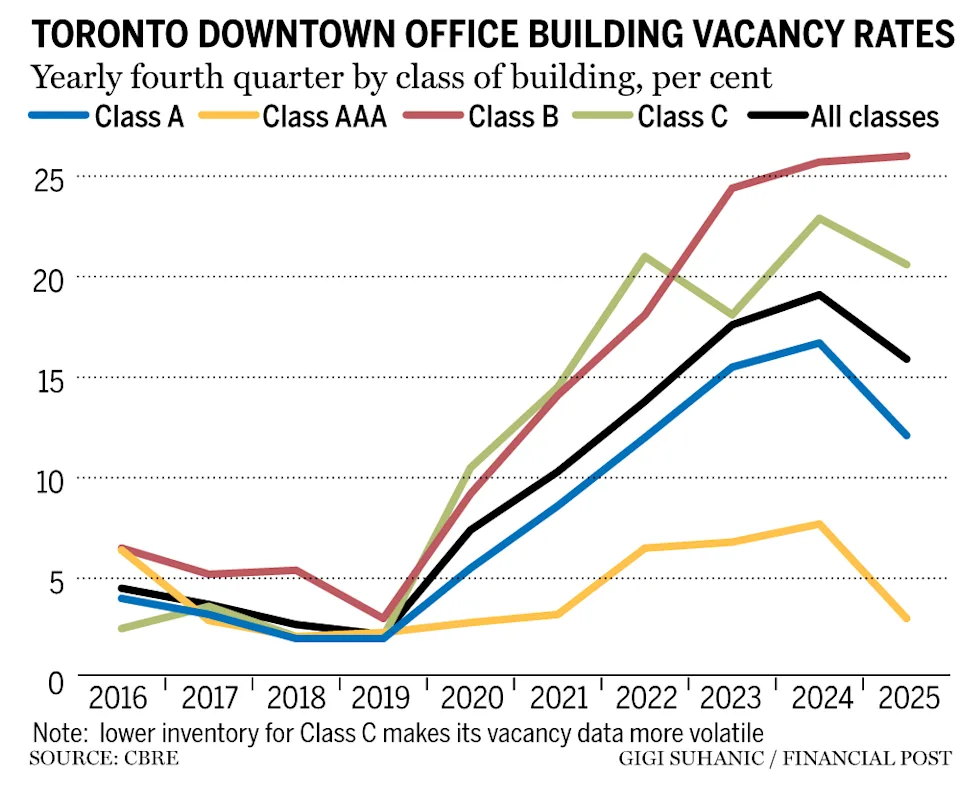
Trophy class office vacancy in downtown Toronto has plummeted to just 3%, down from nearly 8% only months earlier. Net rents on the best buildings are up 20% year over year, and landlord incentives are shrinking. The top 12 downtown towers now sit below 2% vacancy. (Sources: CBRE Q4 2025, Colliers, Globe and Mail)
Here's the supply side of this equation that makes it especially noteworthy: only 2.8 million square feet of office space is currently under construction across all of Canada, with nearly 70% of it already pre leased. No significant new office supply is expected to deliver in downtown Toronto until 2030 or 2031 at the earliest. Companies also pulled 3.2 million square feet of sublease space off the market in 2025, the most in two decades. The space simply isn't there. (Source: CBRE Canada)
The investment numbers above are not happening in a vacuum. They're being pulled into Toronto by one of the deepest talent pools in North America. The city is home to nearly 300 AI companies that have collectively raised over $5.4 billion in funding. Toronto ranks third globally in AI and Big Data according to the Global Startup Ecosystem Report, and third in North America for overall tech talent according to CBRE's 2025 Scoring Tech Talent index.
The numbers behind the talent pipeline are equally important. Toronto's tech workforce has grown to 334,200, up 14.7% since 2021. The city created 95,900 tech jobs between 2018 and 2023, more than any other North American market. Ontario produces over 86,000 STEM graduates annually. And Canada is actively positioning itself to attract tech workers being priced out of the U.S. market through H 1B visa fee increases, with Prime Minister Carney describing it as a direct opportunity for the country. (Sources: City of Toronto Employment Survey, CBRE, CIC News)
The federal government has backed this momentum with a $2 billion Sovereign AI Compute Strategy over five years. The province expanded the Invest Ontario Fund to $1.3 billion. And U.S. based venture firm Forum Ventures raised $25 million USD specifically to launch 18 new AI companies out of its Toronto studio over the next two years. (Sources: Budget 2024, Invest Ontario, BNN Bloomberg Jan 2026)

While corporate investment drives the demand side of the equation, infrastructure is reshaping the supply side. The Ontario Line, a $27.2 billion, 15.6 kilometre subway with 15 stations, has active excavation underway at all downtown station sites. Tunnel boring machines are arriving for 2026 tunneling. When the line opens in 2031, it will connect neighbourhoods from Exhibition Place through King and Bathurst, Corktown, Pape, and up to Thorncliffe Park with rapid transit access they've never had before. (Sources: Metrolinx, Global News)
Three additional subway extensions will add over 25 kilometres of new rapid transit to Scarborough, Richmond Hill, and western Etobicoke. And on the waterfront, a $975 million tri government investment is creating more than 14,000 new homes in the Port Lands, with first occupancy targeted for 2031 and an eventual population of 100,000 residents. (Sources: City of Toronto, ConstructConnect)
For anyone watching where real estate value is headed over the next decade, transit station locations along the Ontario Line corridor represent the most significant accessibility transformation Toronto has seen in a generation.
None of this guarantees where home prices go next quarter. The market has real challenges right now, including elevated inventory, softening rents in some segments, and genuine economic uncertainty around trade policy. I'm not here to sugarcoat that.
But when I step back and look at where institutional capital is flowing, where jobs are being created, and where the world's largest companies are choosing to expand, the long term picture tells a different story than the one dominating your news feed.
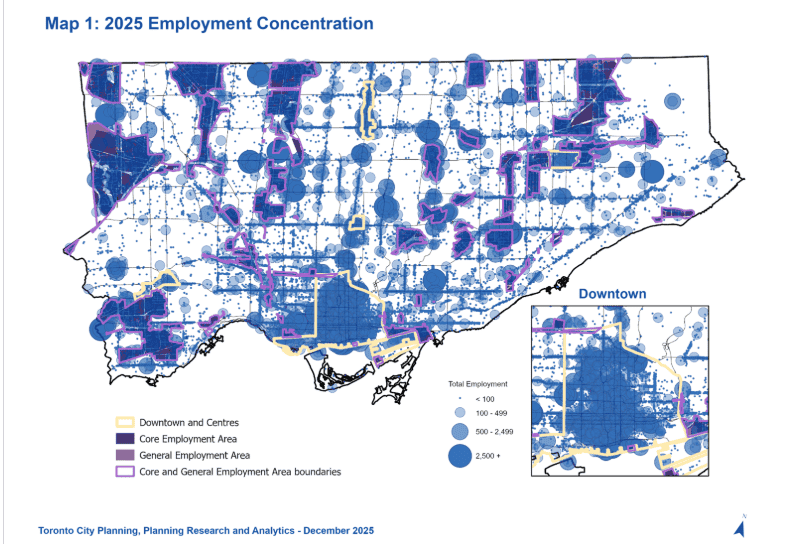
Toronto is the fourth largest city in North America, the financial capital of Canada, and one of the top three tech markets on the continent. More than 334,000 tech workers earn six figure salaries and need housing near transit. Banks employing hundreds of thousands of people are mandating a return to downtown. A $27 billion subway is under construction. And there is effectively no new premium office supply coming until 2031.
The world isn't giving up on this city. It's doubling down.
If any of this raises questions about your own situation, whether you're holding, considering a purchase, or just trying to make sense of things, I'm always happy to talk it through.